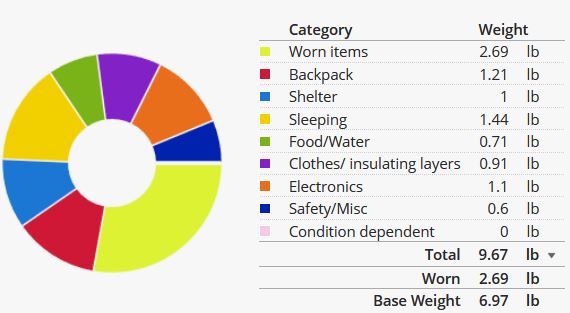
For the past 9 months I have been planning a PCT hike. Originally, I was going to start in Washington and go southbound. 2 weeks ago I flipped my plans and I will be going northbound. This moved up my start date by about a month and a half and I have been busy the past couple weeks with logistics for my hike. Fortunately, I have some prior backpacking experience and I hiked the first 700 miles 4 years ago. I have been gathering my gear for this trip all winter and spring and I am using a kit that is similar to what I have used all over the world.
Resupply Plan
My overarching resupply plan is to keep it simple. I have packed up 3 resupply boxes for myself that will be shipped by my father while I am on trail. My first box will go to mile 442 for pickup at the Acton KOA. My second box is to Grumpy Bears Retreat/Kennedy Meadows (south) at mile 702. My second box has food and my necessary Sierra gear (bear can, additional layers, and microspikes). The final box that will be shipped from home will go to Sierra City at mile 1198. North of Sierra City I plan on purchasing, boxing, and shipping food for a few additional resupply locations where shopping is difficult. Overall, I expect to send about 8 boxes of food to myself but only 3 for the first half of the trail. I will be buying my food from small town supermarkets and grocery stores for all other resupply locations. A deeper dive into my food choices below.
Gear Systems
I am minimalist when it comes to what goes in my pack. In my experience, I find that I would rather add items to my pack if I want them then get rid of items. All items in my pack fill an important role and ideally fill multiple roles. Here is a brief overview of how some of these “systems” work.
Packing
I will be carrying a frameless pack. I will be using my sleeping bad, folded up, as a make-shift frame for the pack to help distribute heavier loads. Within my pack I am using a nylofume plastic bag as a pack liner to keep my stuff dry. Inside I only will be using two stuff sacks for organization. One will contain my food and the other will be holding my small, not oft needed items. Clothes will sit loosely on top of my pack unless it is raining in which I will put them into the packliner.
Sleep System and Clothes
I approach my sleep system and clothes as one system. I will be carrying a lightweight 30° quilt that I will be using in conjunction with a closed-cell foam pad cut to torso length and corners rounded. My backpack will go under my feet and will have extra items in it to double as insulation preventing heat-loss from the ground. I will be sleeping inside a bivy which adds a bit of warmth and doubles as a ground cloth. I will be carrying a tarp for when its raining. I do not expect to pitch my tarp often at all. Site selection will be crucial to prevent condensation and dew as well as maximizing heat retention. My clothes will either be worn on colder nights or used as ground insulation or a pillow, shoes included. In the desert I expect minimal rain but a bit of wind, and thus the windshirt and windpants. I find a fleece to be a more enjoyable hiking layer than a puffy as it breathes well but still insulates, especially under a shell. If it is extremely cold I will wear my windshirt directly on top of my sunshirt, then fleece, then rain jacket. The windshirt will double as a “Vapor-barrier liner,” keeping humidity, and thus heat close to my core. The rain jacket will trap warm and dry air inside. I can also use my extra pair of socks as gloves if necessary. In the Sierra I will be picking up a synthetic puffy jacket, fleece pants, beanie, and gloves for the coldest bit of trail I expect to encounter. I expect to sleep in all my clothes most nights in the Sierra, to push the lower limit of my sleeping bag.
Cooking/water
I will be adjusting my water capacity for dry sections of the trail by buying and recycling bottles as I walk. Gatorade/Powerade bottles are a favorite as it comes with a free tasty drink! Since I will be using bleach (controversial, ~1 drop/L) to purify my water, the mouth of the container isn’t as important. I prefer wide mouth bottles for scooping and filling water. I will have the capacity of about 5L starting and will be able to easily pick-up a few additional liters before the longest dry stretches. I will not be cooking in a traditional sense, instead I will be using a whole foods gelato jar to “Cold soak” my food. In reality, it means lukewarm food ready with minimal prep. When it is ready I can sit down and chow down with no messing with a stove, lighter, dishes, nor food I need to wait to eat because it is hot.
Food
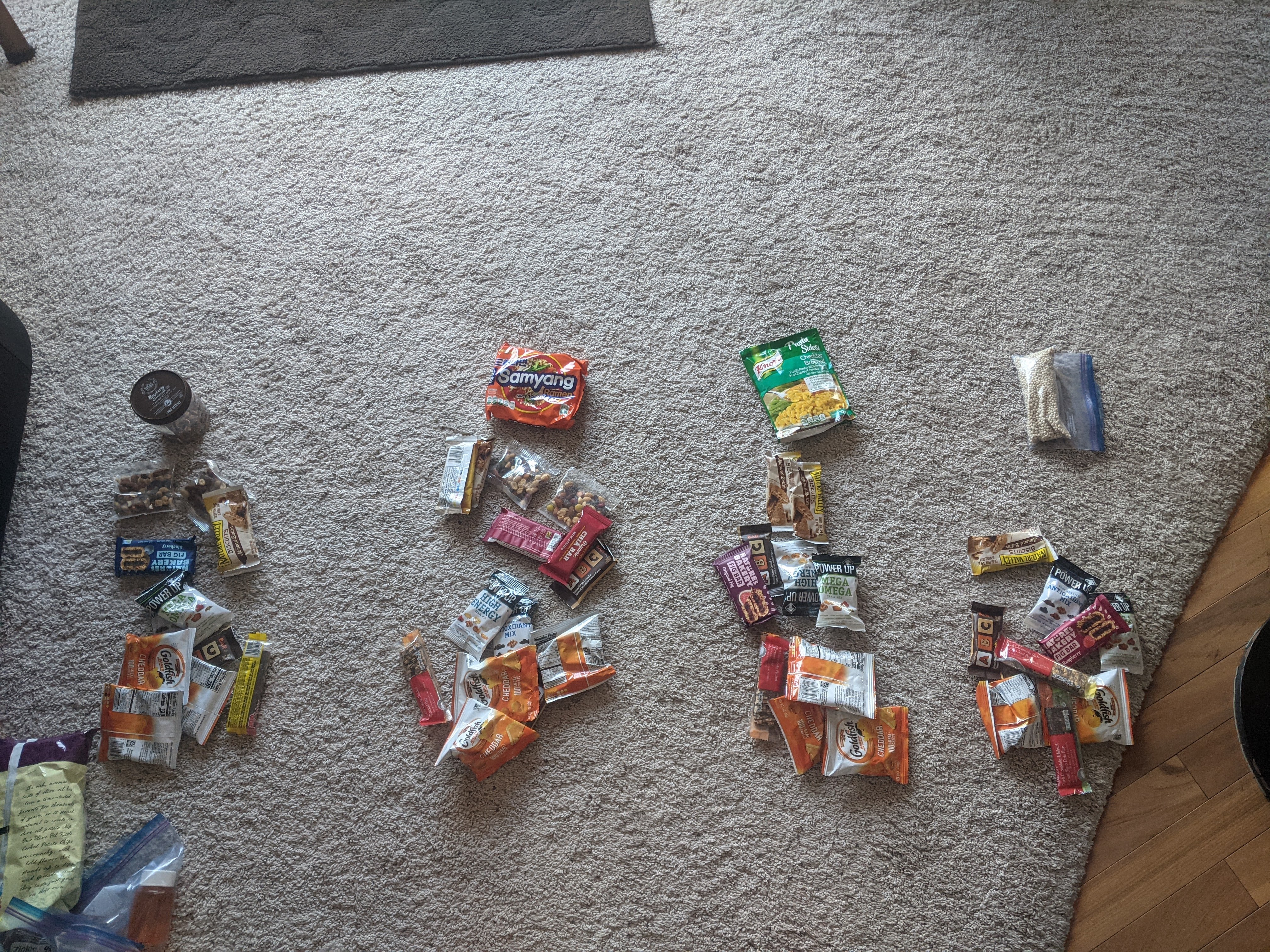
I approach my food with 3 goals: simple, food I want to eat, and calorically dense. I plan on consuming 3,000 calories of food per day for the first week+ of hiking and then I will ramp it up to 4,000 calories (or more) per day when the hiker hunger kicks in. My diet is heavy on fats utilizing nuts and oils. Dinner will be fortified with a generous portion of olive oil (260c/oz) and snacks will be heavy on nuts either in bars or trail mix. I will try to cut back on my overall sugar intake unlike in years past but the thru-hiker staples (poptarts, clif bars, trail mix, ramen, and chocolate) will still make an appearance. In the desert I will be mixing in gatorade powder to some of my water to replenish my electrolytes. Dinners will typically be ramen, dehydrated beans (not dry), Knorr sides, or couscous. Breakfast will be “breakfasty” bars such as fig bars and belvita bars. I will be skipping a traditional lunch in favor of food I can eat on the go: bars, dried fruit, trail mix, and sometimes chips.
 Samuel D. Parks